

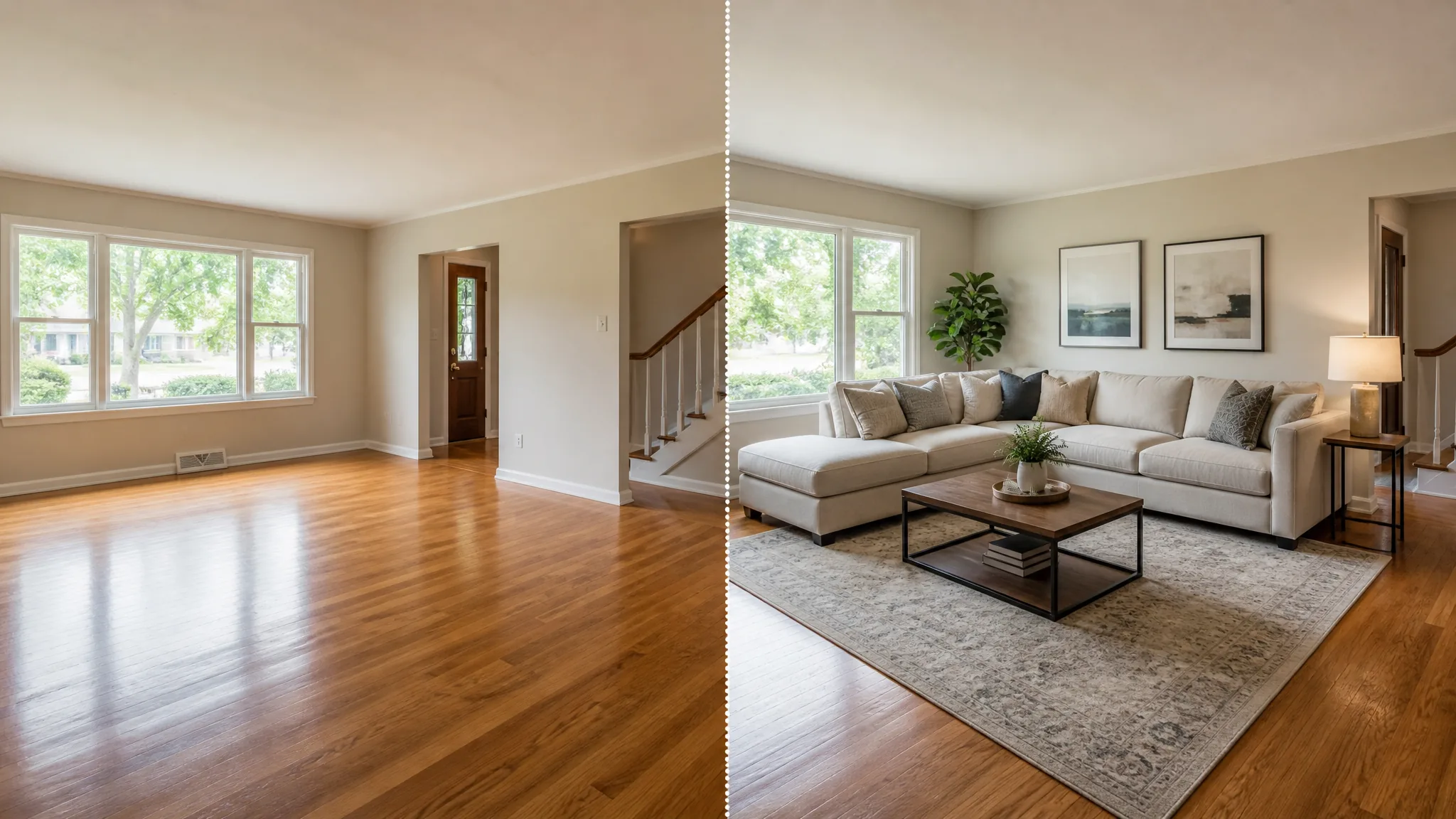
TL;DR. Virtual staging is digitally adding furniture and decor to listing photos of vacant rooms. The 2026 workflow is five steps: shoot a clean wide-angle photo, pick an AI staging tool such as AgentLens, select a style that matches your buyer, run the AI render, then add a small disclosure label before uploading to the MLS. Cost runs about $0.10 to $0.20 per image with AI, versus $1,500 to $3,000 for traditional in-person staging. The whole process takes under ten minutes per room. See our pricing breakdown for plan options.
Vacant listings sit on the market longer and sell for less. Virtual staging fixes that without renting a truck of furniture. In this guide, we walk through exactly how to do virtual staging from the photo you start with to the disclosed image you upload to the MLS. We use our own product, AgentLens, plus two tested alternatives, REimagineHome and Virtual Staging AI. The steps work the same whichever tool you choose.
If you are still deciding whether virtual staging is right for your listing, read the virtual staging cost guide first. If you already know it is, this is the workflow.
What real agents are saying about virtual staging in 2026
Before the steps, the honest peer view on this question. A March 2026 r/realtors thread asked, "What is virtual staging leading to for buyer trust?" The replies were not promotional. Agents reported strong online engagement from staged photos but cautioned about buyer letdown when the in-person tour did not match the rendered image. That gap is where the disclosure label and the right style choice matter most. We linked the thread below so you can read the full discussion.
r/realtors · "What is virtual staging leading to for buyer trust?" · posted March 2026. A working-agent discussion about the gap between staged photos and the real-world walkthrough. Read the original thread on reddit.com for the full set of replies and live comment scores.
The takeaway: virtual staging works as a listing-photo upgrade, not as a substitute for cleaning, painting, and a small physical touch up before showings. Use it to win the scroll and the click. Plan the in-person experience to match.
Watch: a 10-minute virtual staging walkthrough
If you prefer to see the workflow before you read it, this video covers the basic pattern. The presenter walks through an end-to-end stage on a vacant room using a popular browser-based staging tool. It is the most-watched single-video tutorial on the search result page for this topic.

The video uses a click-and-drag interface. Modern AI staging tools work differently. You upload one photo, pick a style, and the model generates a fully staged version in seconds. We cover both patterns in the steps below so you can pick the one that fits your speed and budget.
What is virtual staging?
Virtual staging is the digital editing of a listing photo to add furniture, rugs, art, and decor to a vacant or sparsely furnished room. The output looks like a photo of a furnished home, but no physical furniture was moved. Modern virtual staging is done with AI tools that generate the staged version in seconds, replacing the older drag-and-drop method that took an editor an hour per room.
There are two flavors. Drag-and-drop staging lets you place individual furniture items on a canvas, like Photoshop with a furniture library. AI virtual staging auto-generates the staged room from a single photo and a style prompt. Drag-and-drop gives more control but takes 30 to 60 minutes per room. AI staging takes 10 to 30 seconds and costs a fraction of the per-image price.
In this guide we focus on AI staging because that is what agents are actually using day-to-day in 2026. If you want a deeper comparison of the two approaches, the virtual staging vs real staging breakdown covers the ROI math.
The 5-step virtual staging workflow
We tested this exact workflow across three tools. The steps are the same in each. Only the upload interface and pricing differ.
Step 1. Shoot or pick a clean source photo
The quality of the staged result depends on the photo you start with. Bad input gives bad output, no matter which AI tool you pick. Three rules.
First, shoot wide. Use a wide-angle lens or a phone in 0.5x mode. AI staging tools work best with a full room view that shows two walls and the floor. Tight crops produce smaller staged areas and less convincing results.
Second, level the camera. Tilt produces converging vertical lines. The AI then has to guess where the floor ends, which often leads to floating furniture or scale errors. Use a tripod or set the phone on a stable surface at chest height.
Third, light the room evenly. Open the blinds, turn on the overhead lights, and shoot during the day. Avoid harsh shadows. The AI uses lighting cues to place objects and match the existing tones, so even diffuse light gives a cleaner result.
If you are shooting on an iPhone, the iPhone real estate photography playbook covers settings and gear in detail.
Step 2. Pick the right AI staging tool
We tested three tools that cover the main price tiers. All three produced acceptable results on a vacant living room test. Pick based on how often you stage and where you want to work.
AgentLens: Chrome extension workflow

AgentLens is a Chrome extension that runs staging inside your browser. Install it from the Chrome Web Store, sign in with Google, and the side panel handles the rest. You drag a photo onto the panel, pick a style preset, and the staged version appears in 30 to 60 seconds. One credit equals one staged photo.
Pricing: 10 free credits on signup with no card. Paid plans start at $9.90 a month for 50 credits, $19.90 for 150, and $50 for 500. Yearly billing knocks 20 percent off. Full details on the pricing page.
Best for: agents who want a fast, no-context-switch workflow. You stay in the same browser window for the upload, the stage, and the disclosure-label download. We use it for everything except commercial real estate, where we use a different tool that handles larger spaces.
REimagineHome: web app with style control
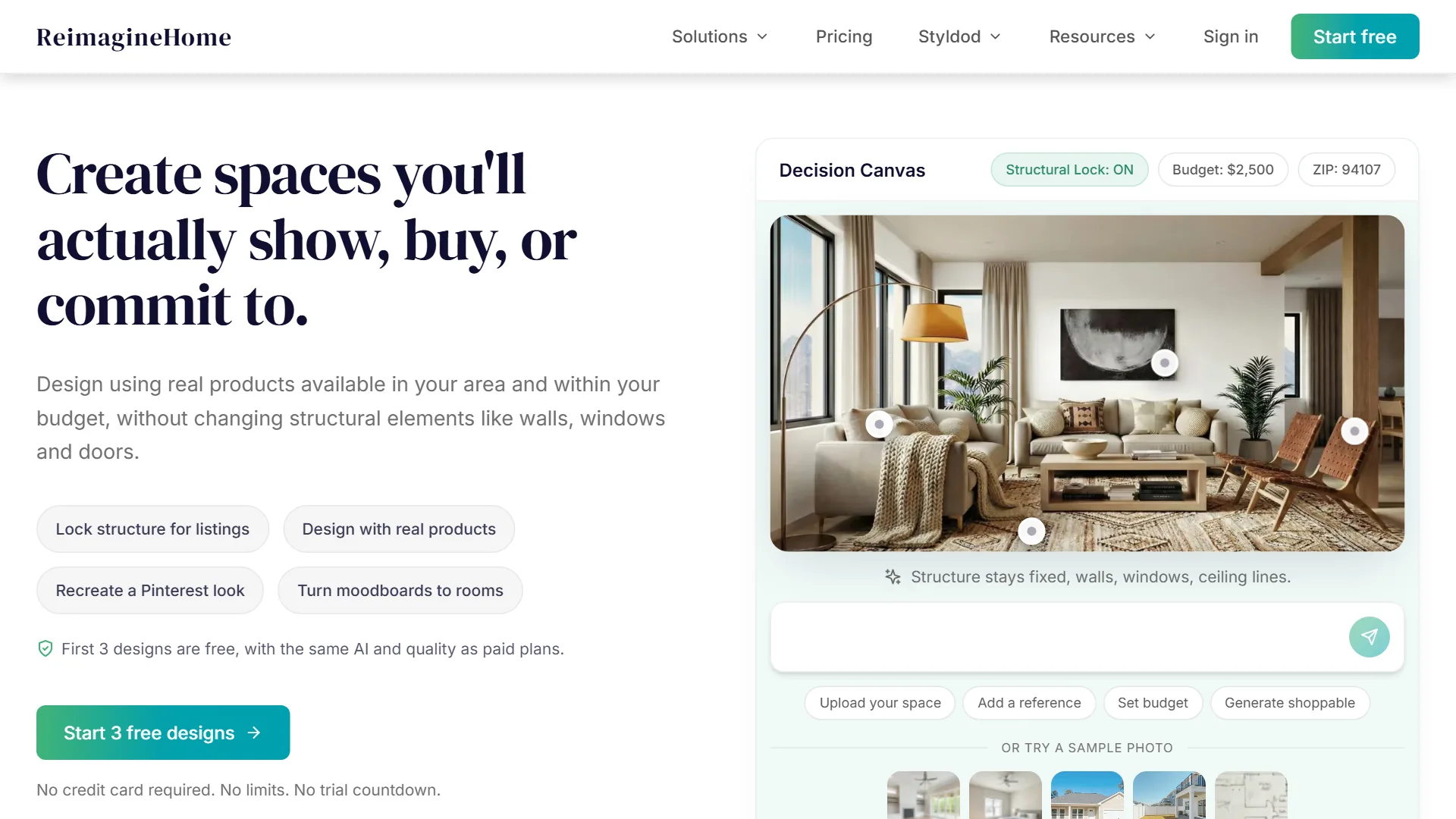
ReimagineHome runs as a web app at reimaginehome.ai. It accepts a photo, a budget, and a ZIP code, then generates a staged version using real products it claims are available in your area. The interface is heavier than a single-click tool, but the output quality is consistent. It also handles exterior shots, which not every AI tool does well.
Pricing: three free designs on signup, paid plans start around $19 a month with watermark removal.
Best for: agents who want to stage exteriors as well as interiors, and want a tool that ties styles to real product catalogs. The free tier is enough to test two listings before you decide.
Virtual Staging AI: per-image pricing
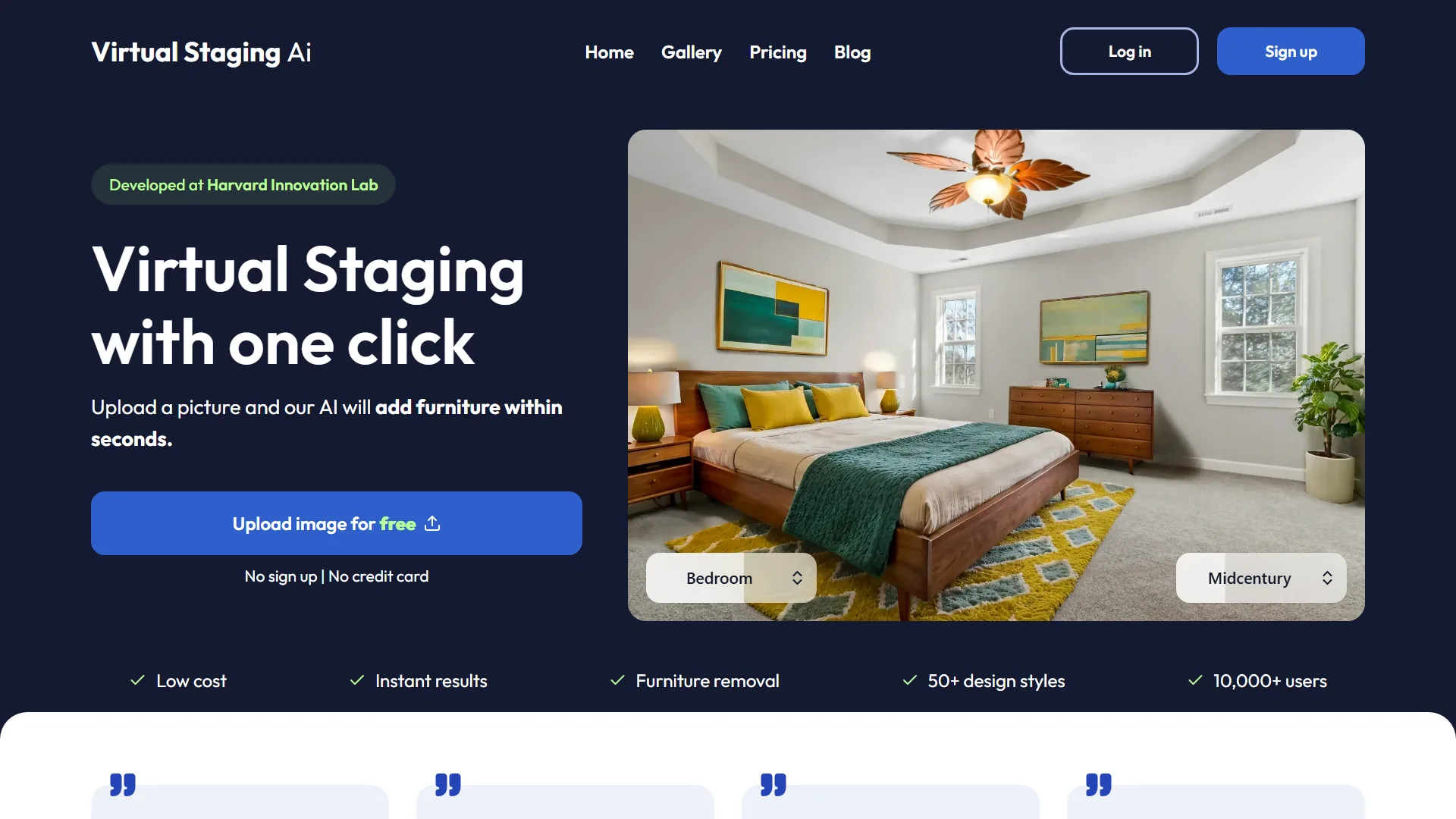
Virtual Staging AI is a no-signup-needed web upload at virtualstagingai.app. Click the upload button, pick a style, get a staged image back in under a minute. It has a per-image pricing option in addition to subscriptions, which is rare in this category.
Pricing: free first photo with no card required, then per-image rates starting around $16 per image or subscription tiers from $16 a month.
Best for: agents who stage fewer than 4 to 5 rooms per month. The per-image pricing is cheaper than a subscription if your volume is low. If you stage more, switch to a subscription tool.
Step 3. Choose a style that matches your buyer
The style picker is where most agents either win or waste credits. Three rules.
First, match the home, not your personal taste. A 1970s ranch staged in modern minimalism will read as a Photoshop job. The buyer expects a style consistent with the architecture, the neighborhood, and the price point. Modern farmhouse works in suburbs. Mid-century modern works in postwar tracts. Coastal works in beach towns. Pick the style that the in-person buyer will not be surprised by.
Second, watch the scale. AI staging models occasionally place oversized furniture in small rooms. A king-bed-sized couch in a 10-by-12 living room reads as obviously generated. Most tools have a "small room" or "studio" preset. Use it when the original photo shows tight wall-to-wall spacing.
Third, fewer items beats more. Overcrowded rooms hide the floor plan and the natural light. Buyers want to picture their own things in the space. A sofa, a coffee table, an area rug, two pieces of wall art, and a plant is usually enough. Skip the styled bookshelf and the kitchen island fruit bowl. They never read as natural.
For style inspiration, see our design styles hub with examples for every major aesthetic.
Step 4. Generate and review the staged photo
Run the AI render. Most tools deliver in 30 to 90 seconds for a single image. Then review on a full-size screen, not the thumbnail. Look for four common artifacts.
Floating furniture. Furniture that does not touch the floor cleanly, or that has a soft shadow on the wall behind it. This usually means the AI guessed the wrong floor angle. Re-run with the same photo and a different style, or use a tool's "redo" or "regenerate" button.
Doubled features. Two coffee tables, a couch with extra cushions, a wall art piece overlapping a window. AI staging models occasionally hallucinate symmetry. Pick a different output from the regenerate set, or trim with a basic image editor afterward.
Wrong scale. Bed clearly too small for the room, or a sectional that fills space that does not exist. This is the most common artifact in vacant houses with very wide-angle photos. Use a less aggressive style preset, or split the photo into a tighter crop before uploading.
Color clashes. Furniture that does not match the wall color or the natural light direction. AI tools usually pick neutral tones to play safe, but occasionally generate a teal sectional against a warm beige wall. Regenerate. It is one credit.
If after two or three regenerations the result still looks off, the source photo is probably the issue. Re-shoot at a wider angle with better light and try again.
Try AI virtual staging free
We give 10 free credits at signup with no credit card. That is enough to stage two full vacant listings, five rooms each. If the workflow above feels right for your business, this is the fastest way to test it on your next listing.
Install the Chrome extension. 10 free credits on signup, no card required.
Step 5. Add the disclosure label and upload to the MLS
This is the step most tutorials skip. Most US states and most major MLS systems require a disclosure on any AI-edited or virtually staged listing photo. The phrasing varies. The intent is the same: the buyer must know the photo is enhanced and not a snapshot of the current state of the home.
The compliance bar in 2026 looks like this. California's AB 723 made disclosure explicit for AI-edited real estate photos. Florida Realtors guidance has aligned with that approach. Many state and regional MLS rules now require a corner watermark or caption noting "virtually staged" on each enhanced image. The disclosure is small, but failing to include it is a fast way to draw a complaint.
We use a tiny corner watermark that reads "Virtually Staged by AgentLens AI" in 12-point text. AgentLens adds this automatically. Other tools require you to add it in Canva or Photoshop before upload. Whichever tool you use, do not skip this step.
Upload the disclosed photo to the MLS and to your listing on Zillow, Realtor.com, and your brokerage site. If the listing description does not already mention virtual staging, add a short line. Something like "Living room and primary bedroom photos virtually staged. Home is being sold vacant." That covers the description-level disclosure most MLS rules require.
For listing description help, our free listing description generator outputs MLS-ready text that already includes a virtual-staging disclosure paragraph when you tag the photos as staged.
How we tested
We ran the same vacant living room photo through all three tools using the same style preset (Modern Farmhouse). Each tool was scored on photo quality, scale accuracy, generation speed, and the workflow friction from upload to download. We also tested each tool's free tier to make sure new agents can validate the workflow before paying. Pricing is taken from each vendor's public pricing page as of May 2026. We disclose that AgentLens is our own product, so we triple-checked the comparison and ran the test photo through each competitor in a clean browser profile.
Read more about how we evaluate AI staging tools on this site.
Last updated: May 15, 2026. Prices and feature lists are reviewed monthly. The screenshots in this guide were captured directly from each vendor's live homepage on May 15, 2026.
Frequently asked questions about virtual staging
Can I do virtual staging myself?
Yes. Modern AI tools let you do virtual staging without any editing skills. You upload a photo, pick a style, and the model generates the staged version in under a minute. AgentLens, REimagineHome, and Virtual Staging AI all give free starter credits at signup so you can stage your first photo without paying. The skills you need are choosing the right source photo and the right style, both of which we covered above.
What is the process of virtual staging?
The 2026 process is five steps. Shoot a clean wide-angle photo of the vacant room. Open an AI staging tool. Upload the photo and pick a style preset that matches the home's architecture. Run the AI render and review the output for floating furniture or scale errors. Add a small disclosure label and upload to the MLS. The full process takes ten minutes per room.
How much does virtual staging cost?
AI virtual staging costs about $0.10 to $0.20 per staged image on a subscription plan. Per-image pricing without a subscription runs around $16 per image. Traditional in-person staging, by comparison, costs $1,500 to $3,000 per home for a six-week rental. Most agents recover the AI cost on the first showing. For a full breakdown, see the virtual staging cost guide.
Can I try virtual staging AI for free?
Yes. AgentLens gives 10 free credits at signup with no card. REimagineHome gives three free designs. Virtual Staging AI gives one free image. Each free tier is enough to stage at least one room and decide whether the tool fits your workflow. We recommend testing two tools side by side on the same photo before subscribing.
Is virtual staging allowed on the MLS?
Yes, when disclosed correctly. Most MLS systems and most state real estate commissions allow virtual staging on listing photos as long as each enhanced photo is labeled. Common labels include a small corner watermark reading "Virtually Staged" and a sentence in the listing description noting which rooms were edited. California's AB 723 made this explicit for AI-edited photos, and Florida Realtors has aligned with similar guidance. Read your local MLS rules before posting.
How is virtual staging different from physical staging?
Physical staging puts real furniture in the home for showings. It costs $1,500 to $3,000 per home and takes a day to set up. The buyer sees the actual furniture in the actual rooms. Virtual staging only changes the listing photos. The home stays vacant for showings. The trade-off is cost and speed for in-person impact. For listings priced under $1 million, virtual staging usually beats physical staging on ROI. For luxury and high-end homes where buyers expect a fully merchandised walkthrough, physical staging still wins.
What rooms should I virtually stage first?
The living room, the primary bedroom, and the dining room. These three are the most-clicked thumbnails on Zillow and Realtor.com, and they are the rooms buyers care most about. Skip secondary bedrooms unless they are unusually small or oddly shaped. Skip bathrooms and kitchens unless they are vacant and dated, in which case a renovation-visualization preset works better than standard staging. The virtual staging by room and style hub has examples of every room and style combo.
Bottom line: virtual staging in 2026 is a 10-minute, 20-cent workflow
If you take one thing from this guide, take this. The barrier to entry for virtual staging in 2026 is not skill or budget. It is the willingness to spend ten minutes per room on a single photo, pick a style, run the render, and add a disclosure label.
The tools have gotten fast enough that you can stage a five-room vacant listing in under an hour, for under $5 in credits. That is the same listing that used to cost $2,000 in physical staging rental, plus a day of setup and a week of waiting. The ROI math is not close.
If you have not staged a vacant listing yet, start with one room on your next vacant listing. AgentLens gives you 10 free credits, which is enough to test two listings of five rooms each before you pay anything. Install the extension and run the five-step workflow above on your next listing. Then compare the days-on-market for that listing to the vacant ones you posted last quarter.
That comparison is the only test that matters. The numbers tell the story faster than any tutorial.
Related reading: For the room-by-room workflow on staging vacant listings, see Virtual Staging for Vacant Rooms. It covers which rooms to stage first and the 5-step AI workflow.
Related reading: For a head-to-head comparison of 6 virtual staging tools with a pricing table and free-tier breakdown, see Virtual Staging Software for Real Estate Agents. It covers AgentLens, REimagineHome, Virtual Staging AI, Spacely AI, BoxBrownie, and ApplyDesign.
Related reading: If your showing is tomorrow and you need the listing photos done now, see How to Stage a Vacant Home With AI in 5 Minutes. The exact 5-step workflow with timings, plus the honest case for when AI is not the right tool.
Free Real Estate Tools
Explore our free calculators and AI tools for agents:
Transform Your Listings with AI
Apply professional virtual staging and enhancements in seconds. Start transforming your listings today.
Explore Virtual Staging Options
Start with our most popular room & style combinations: