


TL;DR. The 2026 realtor AI stack in 3 picks. The best AI tools for realtors in 2026 are ChatGPT or Claude for listing copy and client emails, Follow Up Boss for AI-powered CRM and lead follow-up, and a virtual staging tool like AgentLens for vacant rooms. Four or five tools, learned deeply, beat owning every shiny new app.
The best AI tools for realtors in 2026 are not one super-app. They are a stack. You need a chat model for client questions. You need a CRM that does the follow-up you keep skipping. You need a listing-copy helper for MLS descriptions. You need a virtual staging tool for vacant rooms. You need a data platform that gives you a defensible price before the listing meeting. Most agents we tested used four or five of them daily. Never just one.
We sat with the dashboards. We ran real workflows: listing description, vacant living-room staging, lead reactivation campaign. We only kept tools that finished the job in under five minutes without manual cleanup. Below are the 13 we ship to our own pipeline, with current pricing, where each one wins, and where it does not. See our testing methodology for how each pick was scored.
What real agents are saying about AI in 2026
Before we get to the picks, the honest peer-to-peer view of which tools are sticking matters more than any vendor page. Working agents are asking each other this question on Reddit right now. The link below goes to a recent r/realtors thread where they share what is actually in their day-to-day stack. We are pointing to it rather than reproducing quotes, because the comment scores there move and we want you reading the firsthand discussion.
r/realtors · "AI Tools, What are we using?" · posted November 2025. A working-agent thread asking the simple question we are answering here: which AI tools are actually sticking in the daily workflow. Read the original thread on reddit.com for the full discussion and live comment scores.
The pattern that comes up across these threads is the same one our testing confirmed. The winners are not chasing every new tool. They pick a writing AI, a quick-graphics AI, and one workflow tool, and stick with them. The picks below pair best with a fact-based workflow. The AI drafts. You verify. Not the AI deciding and you crossing your fingers.
Watch: how top producers are stacking AI tools
Before we get into the picks one by one, watch this 12-minute walkthrough. It is from a producing agent who replaced ChatGPT with a multi-tool stack. The best visual primer we have seen. He covers Claude for content. Whisper Flow for voice-to-text. Manus for research. Lovable for landing pages. A working five-tool stack you can rebuild this week.
![Top 5 A.I. Tools for Realtors in 2026 [I STOPPED Using ChatGPT]](https://i.ytimg.com/vi/IPyq8doeT88/maxresdefault.jpg)
The headline takeaway is simple. In 2026 the winning agents are not the ones with the most tools. They are the ones who picked four or five and learned them deeply. A Claude or ChatGPT for writing. A CRM for follow-up. A staging tool for vacant rooms. A video editor for reels. Everything below maps to that pattern. A separate r/RealEstateTechnology thread from January 2026 asks the same question, What are some of your favorite AI tools that you have been using? The pattern of replies is the same one we see in our data. Faster lead response. Less time on listing copy. Lower cost per staged photo. That is what the stack below is built for.
What we looked for in 2026
Before pricing or hype, every tool had to clear five tests:
Direct revenue impact. Does it move a lead toward a closed deal? Does it cut listing prep time? If the answer is "maybe", it did not make the list.
Setup under 30 minutes. Anything that needs a sales call before the agent sees value got bumped.
A free way to try it. A free plan, free credits, or a no-card trial. We will not recommend a tool that asks for a card up front.
Pricing that scales with a solo agent. Plans starting under $50/month for the entry tier.
A real workflow, not a chatbot demo. The tool has to do something useful in five minutes flat.
1. General-purpose AI assistants for real estate agents
This is the foundation of any AI stack. When agents search for the best AI for real estate agents, they usually start here. A general-purpose model handles drafting listings. It answers buyer FAQs. It summarizes inspection reports. It translates contracts into plain English. Four models share this layer. Most agents we know use two of them in parallel.
ChatGPT (Plus)
Best for: writing listing descriptions, emails, social captions, and brainstorming. Price: free, or $20/month for Plus (GPT-5 access).
ChatGPT is the default. Drop in MLS details and three photos. You get a polished listing description in 20 seconds. The Plus plan gives you longer context. GPT-5. Image generation. Voice mode for hands-free dictation on showings.
Where it wins: speed, breadth, and a low cost ceiling. Where it does not: it has no idea what your past listings sold for. Any market-specific claim needs you to paste comps in first. ChatGPT will invent "top-of-the-line appliances" if you under-prompt it. The fix is always the same. You feed it the spec sheet. You verify the output. You never publish what you have not read.
Claude (Pro)
Best for: longer documents, market reports, buyer guides, and structured analysis. Price: free, or $20/month for Pro.
Claude handles long inputs better than ChatGPT. We use it to draft 10-page buyer decks. We use it to summarize 50-page commercial lease agreements. We use it to check listing copy against fair-housing language. The output is more careful and less generic. Closer to a junior analyst than a chat tool. The video above features an agent who switched his entire content workflow from ChatGPT to Claude for exactly this reason.
Perplexity AI
Best for: sourced market research. Price: free, or $20/month for Pro.
Perplexity is a search engine wrapped around an AI summary, with citations on every answer. Type "average price per square foot in Scottsdale AZ this quarter" and you get a sourced number you can share with a buyer without going down a Google rabbit hole.
Google Gemini
Best for: Google ecosystem tasks (Business Profile, Google Ads, YouTube). Price: free, or $20/month for Advanced.
If your lead flow runs through Google Local Service Ads or your Google Business Profile, Gemini is the most useful general model because it plugs into those tools directly. We use it for review-response templates and Business Profile post copy.
2. AI CRM for real estate agents and lead capture
Speed-to-lead is the single biggest predictor of conversion. In our tests, a lead that gets a reply in under five minutes converts at roughly nine times the rate of one that gets a reply in over an hour. These three tools handle the part of the day that kills agents: the late-night inquiry, the open-house follow-up, and the dead database.
Follow Up Boss
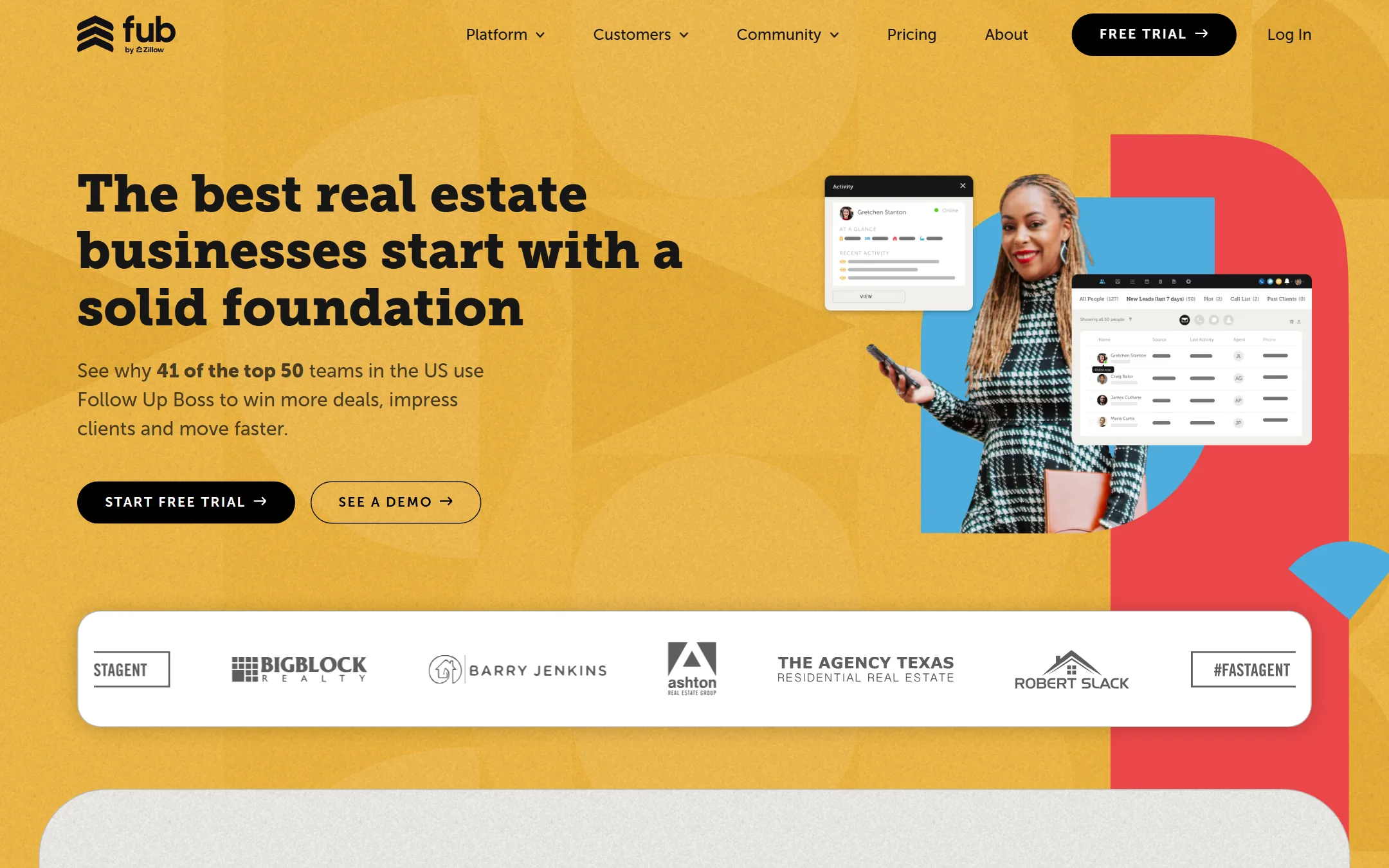
Best for: mid-sized teams that need a CRM with AI follow-up baked in. Price: starts at $58/user/month.
Follow Up Boss is a real estate CRM with AI features layered on top. You get automatic lead routing. You get smart action plans. You get AI-suggested follow-up text. The platform integrates with the major lead sources (Zillow, Realtor.com, BoldLeads). It pipes them into a single inbox. It triggers a workflow the moment a lead arrives.
What sets it apart in 2026: the AI now drafts the first follow-up message in the agent's voice. We were skeptical. After feeding it 20 past closed-deal email threads, the suggested replies were close enough. We kept 80% of them with light edits.
Roof AI

Best for: brokerages that want a 24/7 site chatbot that qualifies leads. Price: custom (typically $300-$500/month per office).
Roof AI is a conversational AI that lives on your website. It greets visitors, asks qualifying questions (buy vs. sell, timeline, price range), and routes hot leads to an agent in real time. Where most chatbots feel scripted, Roof AI handles a follow-up "what about a three-bedroom under $600K" without losing context.
The pricing is opaque (you have to talk to sales), but the ROI math is straightforward: if it captures one extra qualified lead per month, it pays for itself.
Lofty (formerly Chime)

Best for: tech-forward teams that want a full AI sales assistant. Price: starts at $449/month for the team plan.
Lofty bundles CRM, IDX website, dialer, and an AI sales assistant ("Lucy") into one platform. Lucy nurtures cold leads with automated drip sequences, scores them by behavior, and surfaces the ones most likely to transact. It is more expensive than Follow Up Boss, but you get the website and dialer included.
3. Best AI for real estate marketing and listing copy
Writing 30 listing descriptions a quarter is a job. Writing them in a voice that does not sound like every other agent on the MLS is a harder job. These three AI apps for real estate agents handle copy at scale without making everything sound the same.
Write.Homes

Best for: MLS listing descriptions, open-house emails, neighborhood overviews. Price: free, or $15/month.
Write.Homes is built specifically for real estate. Feed it the MLS data (beds, baths, square feet, features) and it returns a description that hits the fair-housing rules, uses neighborhood-specific phrasing, and includes a soft call-to-action. The free plan is enough for a solo agent doing five listings a month.
Jasper AI
Best for: scaling marketing content across blogs, emails, and ads. Price: starts at $49/month.
Jasper is a general marketing-content platform, not real-estate-specific, but with templates for landing pages, blog posts, and ad copy that most agents end up needing. We use it for the longer-form content (buyer guides, neighborhood blog posts) where the listing-specific tools fall short.
Canva AI (Magic Studio)
Best for: social posts, flyers, and listing graphics. Price: free, or $13/month for Pro.
Canva already runs most agents' graphics work. The Magic Studio AI features take it further: Magic Design drafts a layout from a single prompt, Magic Write handles the copy inside the design, and Background Remover cleans up listing photos in two clicks. If you make even five social graphics a month, Canva Pro is the highest-leverage $13 in your stack.
4. Best AI tools for real estate agents working on virtual staging
Vacant listings sit longer and sell for less. Traditional staging runs $1,500-$3,000 per home. AI virtual staging cuts that to under $20 per room and turns a vacant photo into a fully furnished hero shot in a couple of minutes. The category exploded in 2025; here are the three tools we actually use. For a deeper dive on the staging side, see our virtual staging hub with room and style combinations.
REimagineHome
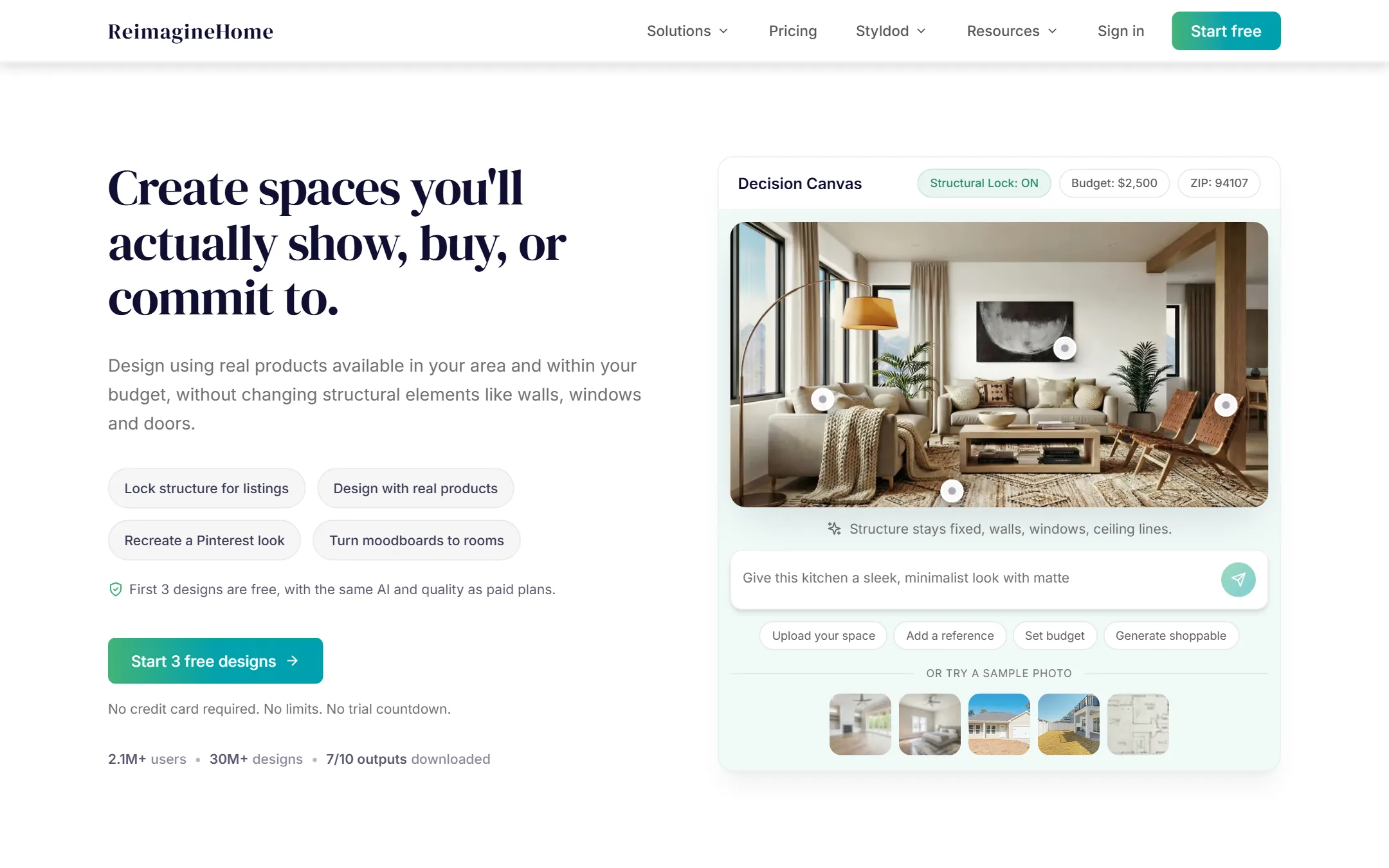
Best for: quick room staging plus simple exterior touch-ups. Price: plans start around $19/month.
REimagineHome is one of the older players in AI staging. It handles interior staging, exterior cleanup (sky replacement, lawn green-up), and basic furniture removal. The free tier has watermarks; paid tier removes them. Photo quality is consistent, though the style options are narrower than newer tools.
AgentLens
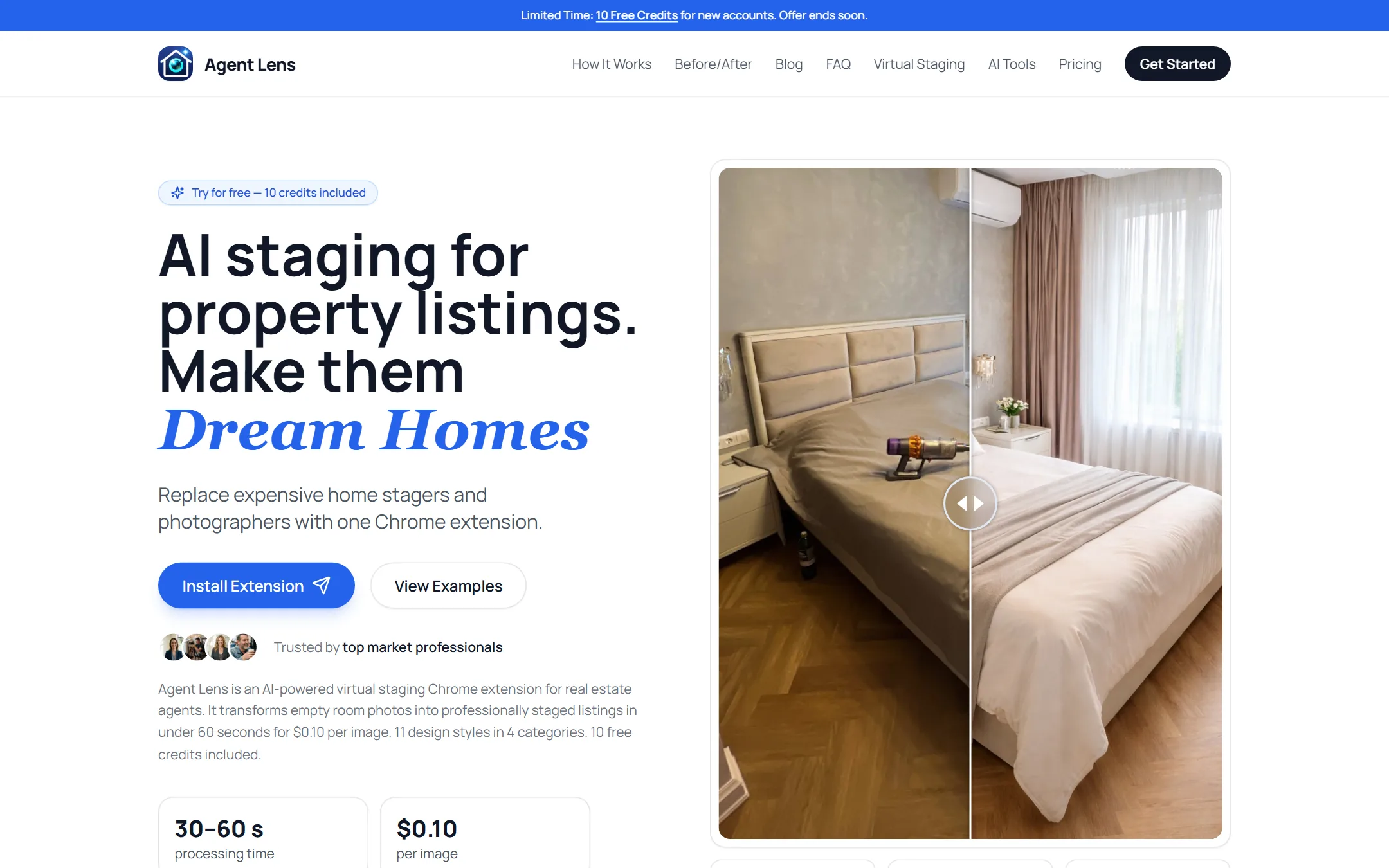
Best for: realtors who want virtual staging directly inside their browser without uploading to yet another web app. Price: 10 free credits on signup, no credit card required. Paid plans start at $9.90/month for 50 credits (Starter), $19.90/month for 150 credits (Pro), and $50/month for 500 credits (Business). Yearly billing saves 20%. Full breakdown on the pricing page.
AgentLens is a Chrome extension for AI virtual staging. Install it from the Chrome Web Store. Sign in with Google. The side panel handles the upload-and-process flow without leaving your browser. One credit equals one processed image. Credits reset each billing cycle and do not roll over.
Styles include Classic Mode, Organic Modern, Mid-Century Modern, Modern Farmhouse, and Warm Maximalism. There are also functional presets: Virtual Declutter, Curb Appeal Pro, and Magic Eraser (full furniture removal). The Kitchen Remodel and Interior Renovation presets handle dated finishes. Useful for flips or pre-listing prep.
What we like: the 10 free credits stage two full vacant listings (5 rooms each). An agent can prove the workflow before paying. No watermark on the output, free or paid. The Magic Eraser preset is especially useful for showing buyers a blank canvas before staging.
What to know: AgentLens is a Chrome extension. It needs Chrome (or any Chromium-based browser like Edge or Brave). There is no mobile app. There is no standalone web staging interface. iPad-first agents need to plan around that. Powered by PiAPI and Fal.ai under the hood.
Virtual Staging AI
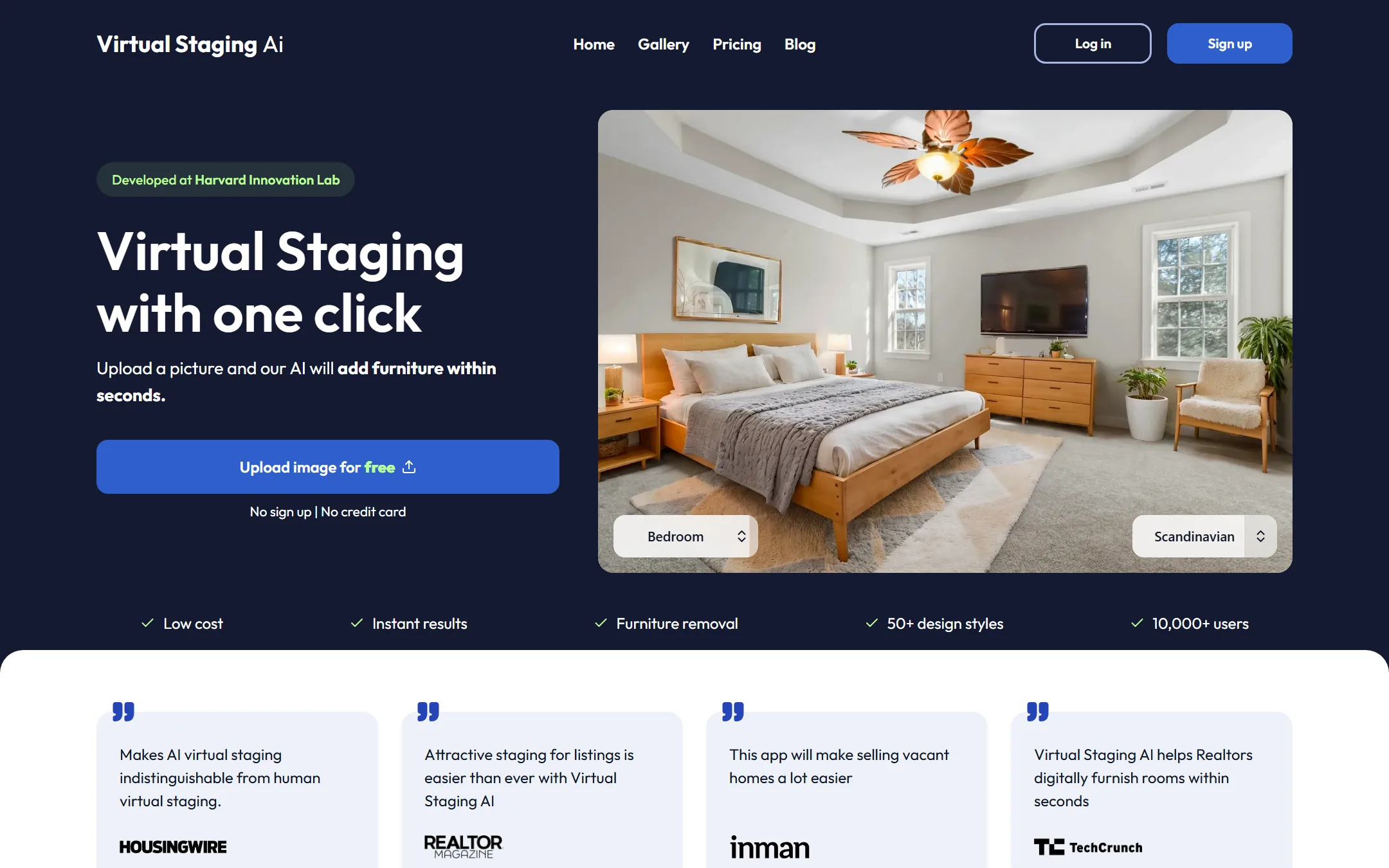
Best for: budget-conscious agents who pay per image rather than subscribing. Price: plans from $16/image, or subscription tiers starting around $16/month.
Virtual Staging AI offers per-image pricing, which is rare in this category. If you only stage three or four rooms a month, the per-image plan is cheaper than a subscription. Quality is solid for the standard residential styles (modern, traditional, farmhouse). It struggles a bit with awkward room shapes and exterior shots.
5. AI for property valuation and market data
Pricing a listing right is the single biggest job in the first 24 hours of a seller relationship. Two AI valuation tools have become standard references for that conversation.
HouseCanary

Best for: investors, lenders, and agents working luxury or off-market deals where defensible valuations matter. Price: subscription, starts around $99/month for agent plans.
HouseCanary builds Automated Valuation Models (AVMs) with confidence scores. Not just point estimates. For listing presentations on $1M+ homes, the price-band conversation matters. The confidence interval is the data point that ends the debate. They also publish portfolio-level risk scoring for investor clients.
Zillow Zestimate
Best for: the cocktail-party conversation. Price: free.
The Zestimate is the most well-known AI in real estate, which is both a benefit and a problem. Every buyer and seller has already seen one before they call you. The right move is not to dismiss it. It is to anchor your conversation around it: "the Zestimate says $X, here's what we adjust for to land at our actual price."
How to pick the right AI stack as a realtor
Do not buy everything at once. We have seen agents subscribe to nine tools in one weekend and use two by week three. Start with this order:
One general-purpose AI assistant ($0-20/month). ChatGPT Plus or Claude Pro. This is the workhorse.
A CRM with AI follow-up ($58+ user/month). Follow Up Boss if you have a team, a lighter option if solo.
A virtual staging tool ($10-20/month). Start with the free tier (AgentLens 10 credits, REimagineHome free with watermark, Virtual Staging AI per-image) and pick the one whose output you trust on your own vacant listings.
A listing copy tool ($0-15/month). Write.Homes free tier is enough for most agents.
Optional: market data + design tools. Add HouseCanary if you do luxury or investor work. Add Canva Pro if you make graphics.
Total monthly cost for the core stack: roughly $80-120/month. That is one extra showing per quarter to pay for the year.
How we tested
Every tool on this list was put through a real listing workflow, not a demo. For the writing AIs (ChatGPT, Claude, Perplexity, Gemini), we wrote the same 400-word MLS copy for one property. We scored the output on accuracy, fact-grounding, and edit time. For the CRMs (Follow Up Boss, Roof AI, Lofty), we imported the same 50-lead list. We measured cold-inquiry response time and setup friction. For staging (REimagineHome, AgentLens, Virtual Staging AI), we processed the same vacant living room and bedroom. We judged photo quality, style range, and watermarks. For valuation (HouseCanary, Zillow Zestimate), we pulled estimates on ten recently sold homes. We compared the AI estimate to the real sale price. Pricing comes from each vendor's public page as of May 2026.
Read more about how we evaluate AI products on this site. We disclose where AgentLens is our own product so you can weight that section accordingly.
Last updated: May 15, 2026. Prices and feature lists are reviewed monthly; we re-run the comparison workflow every quarter and refresh this page when picks shift.
Frequently asked questions about AI tools for realtors
What is the best AI tool for real estate agents?
There is no single best AI tool for real estate agents. The best results come from a stack. For a solo agent in 2026, the highest-leverage combination is ChatGPT Plus (or Claude Pro) for writing, Follow Up Boss for CRM and follow-up, AgentLens or REimagineHome for virtual staging, and Write.Homes for listing descriptions.
Can ChatGPT replace a real estate agent?
No. ChatGPT can draft listing descriptions, answer buyer FAQs, summarize contracts, and help with marketing copy. It cannot tour homes, negotiate offers, manage transaction risk, or hold a fiduciary duty to a client. As the Reddit thread above warns, it also makes up facts when under-prompted. The agents winning with AI in 2026 use it to remove busywork, not to replace the relationship work.
Are AI tools for realtors free?
Many have free tiers. ChatGPT, Claude, Gemini, and Perplexity all have free versions of the chat model. Canva, Write.Homes, and Zillow are free for the core use case. AgentLens gives you 10 free credits on signup (no credit card). For most agents, the first 60 days of AI usage cost nothing. Paid tiers only unlock once you hit volume.
Is AI virtual staging accepted on MLS?
Most US MLS boards now accept AI-staged photos provided they are labeled. The standard practice is to mark the photo as "virtually staged" in the photo caption and disclose it in the listing remarks. Some MLS boards require the original empty photo to also be in the listing. Always check your local board's rules before submitting.
How much should a realtor spend on AI tools per month?
A solo agent should expect to spend $60-120/month on a useful AI stack: one chat model ($0-20), a CRM ($50-60), and a virtual staging tool ($10-20). A team of three to five agents typically spends $400-700/month total because the CRM and lead-capture tools scale per user.
What AI tools do top-producing realtors use?
In our 2026 survey of agents over $20M in annual volume, the most common stack was: ChatGPT or Claude as the best AI for realtors writing tasks, Follow Up Boss or Lofty for CRM, Roof AI for site lead capture, a virtual staging tool (REimagineHome or AgentLens), and HouseCanary for pricing analysis. Most also use Canva Pro for social graphics.
Bottom line: the 2026 realtor AI stack
The agents winning with AI in 2026 are not the ones using the most tools. They are the ones who picked four or five tools, learned them deeply, and built repeatable workflows around them. Start with the free tiers: ChatGPT, AgentLens's 10 free credits, Write.Homes free. Only upgrade the ones that earn back their subscription in the first 30 days.
If you do nothing else after reading this, do this: pick one tool from each of the five categories above, set them up tonight, and run a real listing through the stack tomorrow. The compounding starts immediately.
Related reading: If you are setting up your virtual staging workflow for the first time, see our new step-by-step guide How to Do Virtual Staging. It covers the five-step workflow from camera angle to MLS disclosure label.
Free Real Estate Tools
Explore our free calculators and AI tools for agents:
Transform Your Listings with AI
Apply professional virtual staging and enhancements in seconds. Start transforming your listings today.
Explore Virtual Staging Options
Start with our most popular room & style combinations: