

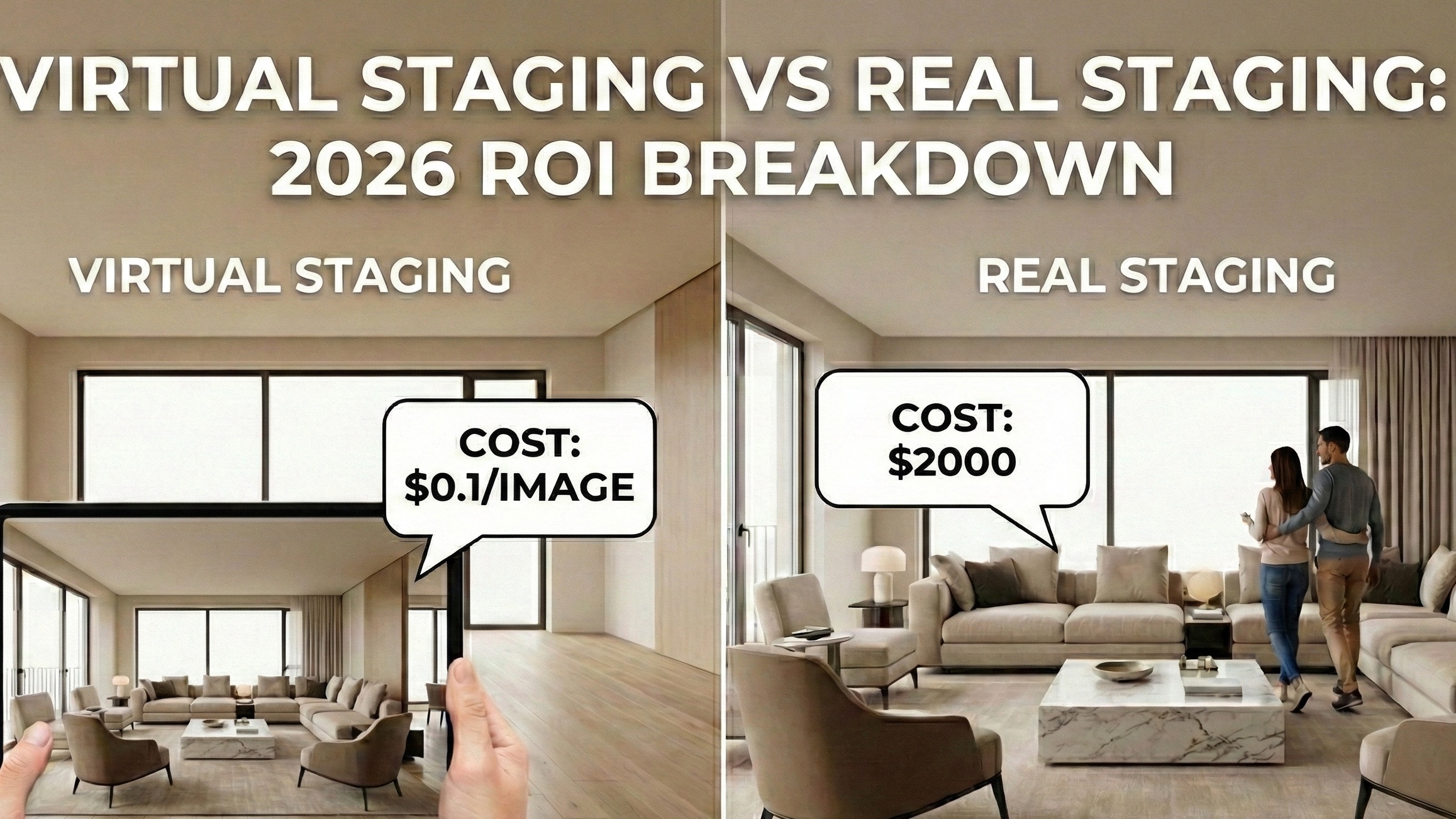
1. Introduction: The Two-Second Rule
In 2026, the "curb appeal" moment happens on a phone screen, usually while the buyer is sitting on their couch. You have exactly two seconds to stop the scroll.
If a buyer sees beige walls, dated yellow brick, or a vacant room that echoes, they don't see potential. They see a project. They see weekends lost to contractors and Home Depot runs.
Your job isn't just to sell a house; it's to solve the "visualization deficit." You have to bridge the gap between what is and what could be before they swipe left. The industry has argued about Real Staging vs. Virtual Staging for a decade. But with interest rates stabilizing and inventory tightening, the math has changed.
Here is the definitive ROI breakdown for 2026.
2. The Psychology of the Scroll: Why Staging is Non-Negotiable
Buying a home is an emotional decision justified by logic later. In 2026, that emotional hook has to happen digitally.
The Cost of an Empty Room
An empty room forces the buyer to work. They have to guess if a King bed fits between the windows. They have to imagine warmth where there is only drywall. Most buyers can't do it.
The Stat You Need to Know: According to the 2025 NAR Profile of Home Staging, 83% of buyer's agentssaid staging made it easier for a buyer to visualize the property as a future home.
Without staging, you lose that 83%. They click "back" and find a listing that tells them a better story.
"Scroll Appeal" vs. Curb Appeal
Physical staging engages the senses—smell, touch, sound. It’s powerful during a tour. But 97% of home searches start online. If your thumbnail doesn't promise a lifestyle, they never book the tour to smell the cookies or touch the sofa. You need to win the screen first.
3. Real Staging: The Luxury Heavyweight
Physical staging is still the gold standard for tactile experience. It involves a designer, movers, and rental furniture.
The Logistics (The Heavy Lift)
Consultation: A designer measures and plans ($150–$600).
Logistics: Movers haul furniture in. You need insurance and scheduling.
Timeline: It typically takes 2 to 4 weeks to get furniture installed and photographed.
The Price Tag Real staging is expensive.
Upfront: $2,000 – $5,000 for a standard setup.
Recurring: If the home sits, you pay $500–$2,000/month in rental fees.
Luxury: High-end estates can cost $30,000+.
When Real Staging Wins Despite the cost, physical staging is unbeatable for:
Luxury Listings ($2M+): Buyers at this level expect to sit on the furniture. The cost is a fraction of the commission.
Vacant, Awkward Layouts: You need physical proof that a sofa fits in that weird triangular living room.
4. Virtual Staging 1.0: The Traditional Services
For years, services like BoxBrownie and Stuccco have been the alternative.
The Process: You upload photos, give instructions, and wait.
The Cost: $24 – $50 per image.
The Wait: 24 to 48 hours.
The Problem: It doesn't scale. Staging a 30-photo listing costs $700+ and takes two days. If you need a revision because the rug looks wrong, you wait another day.
5. Virtual Staging 2.0: The AI Revolution
Generative AI now stages rooms in seconds for pennies. This changes the math entirely. It allows you to stage every room in a listing—laundry rooms, guest beds, patios—creating a consistent visual narrative without blowing the marketing budget.
Enter Agent Lens
This is where Agent Lens changes the workflow. We built a Chrome extension specifically for real estate professionals who need speed without sacrificing architectural integrity.
While traditional services charge $24 per photo, Agent Lens runs between $0.10 and $0.33 per image. You get the result in 10–15 seconds, not two days.
Precision Modes for Every Scenario
Generic AI often "hallucinates"—merging sofas into walls or putting four legs on a three-legged table. Agent Lens uses calibrated modes to respect the room's geometry.
1. Virtual Staging: Choose your style
Organic Modern: The 2026 favorite. Earth tones, boucle, linen. Perfect for city condos.
Mid-Century Modern: Walnut woods and tapered legs. Ideal for 1960s ranches.
Modern Farmhouse: Rustic textures and reclaimed wood. Still huge in the suburbs.
Warm Maximalism: Deep olives, indigo, and velvet. Use this to make a dining room pop.
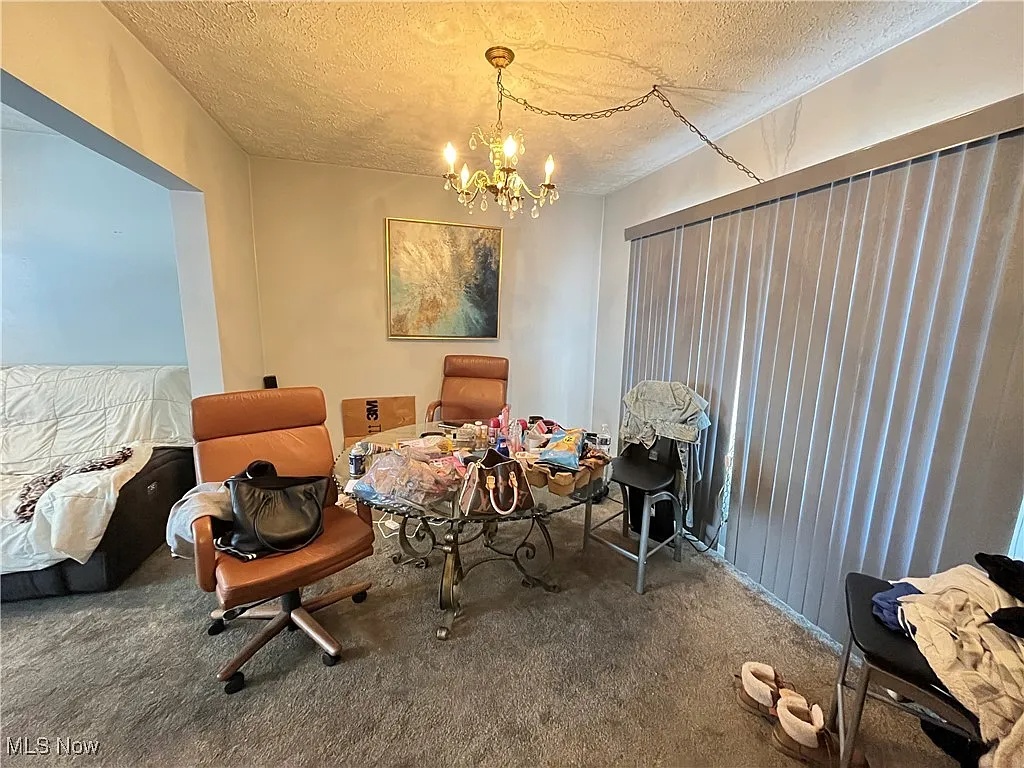
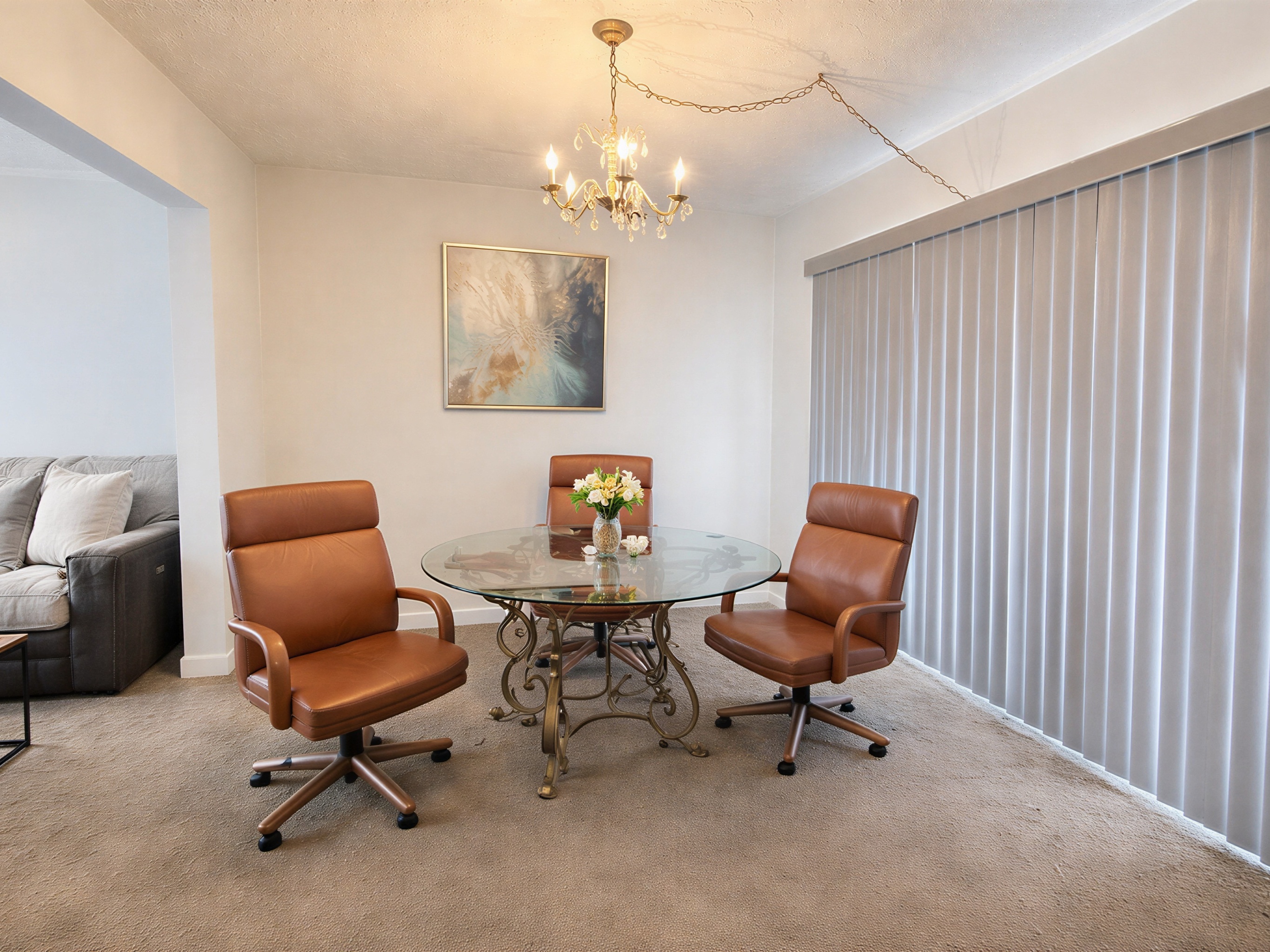
2. Virtual Declutter This is a listing winner. If you have a tenant-occupied home full of clutter, use Agent Lens's 'Virtual Declutter' mode. It wipes the mess (toys, mail, boxes) but keeps the major furniture. You protect privacy while selling the space.
3. Kitchen Remodel Selling a fixer? Don't just tell them it has potential. Show them. This mode replaces dated oak cabinets and laminate counters with modern quartz and shaker styles in seconds.
6. The 2026 Cost Comparison
Here is the reality of the market today.
Feature | Physical Staging | Traditional Virtual (BoxBrownie) | AI Virtual (Agent Lens) |
|---|---|---|---|
Cost | $2,000 - $5,000+ | $24 - $50 / image | $0.10 - $0.33 / image |
Time | 2 - 4 Weeks | 24 - 48 Hours | 10 - 60 Seconds |
Best For | Luxury ($2M+), Open Houses | Key Hero Shots | Volume, Rentals, Fixers |
Flexibility | Low (locked in for 60 days) | Medium (paid revisions) | High (instant regens) |
7. Competitor Analysis: The Honest Truth
We aren't the only tool out there, but we built Agent Lens to solve specific complaints agents have with other platforms.
BoxBrownie: They are the reliable grandfather of the industry. Quality is high because humans do it. But at $24/image, it’s too expensive to stage an entire 40-photo listing.
Behr & Sherwin-Williams Apps: Great for buying paint, bad for visualization. Users consistently report the Behr ColorSmart app crashes during sharing and the Sherwin-Williams ColorSnap scans colors incorrectly (turning beige into salmon pink) due to lighting sensors.
Generic AI: Many cheap tools struggle with "object permanence." You might see a bunk bed with overlapping ladders or a coffee table that floats two inches off the rug.
The Agent Lens Difference: We focused on the "Geometry Lock." Our AI understands that a floor is a floor, ensuring furniture sits on it, not in it.
8. Strategic Workflows to Win Listings
Stop thinking of staging as just "decorating." It's a sales weapon.
1. The "Tenant-Occupied" Win
Walking into a messy rental unit is a nightmare for listing photos.
Old Way: Argue with the tenant to clean up.
New Way: Snap the photos as-is. Use Agent Lens 'Virtual Declutter' to wipe the mess digitally. Show the owner you can market the home without disturbing the tenant.
2. The "Renovation Vision" Board
For FSBOs or investors selling a dated property:
Take a photo of the ugly 1980s kitchen.
Run it through Agent Lens 'Kitchen Remodel'.
Print the "After" photo on a foam board and display it on the kitchen counter during showings. Result: Buyers stop staring at the old cabinets and start discussing the renovation budget.
3. The Hybrid Strategy
For a mid-range listing ($500k–$900k), you don't need $5,000 of physical furniture.
Physically stage the Living Room and Primary Bedroom (the emotional zones).
Use Agent Lens to stage the guest rooms, office, basement, and exterior patio.
You get the full online impact for 1/10th of the price.
9. Legal & Ethical: Don't Be a Catfish
Is virtual staging legal? Yes. Is it deceptive? Only if you lie.
The Golden Rule: You can change the furniture; you cannot change the house (unless you disclose it).
Do: Remove clutter, add furniture, fix lighting, blue-up a gray sky (Agent Lens 'Curb Appeal Pro').
Don't: Remove power lines, hide water damage, or change the view out the window.
Disclosure is Easy:
Watermark: Agent Lens adds a "Virtually Staged" watermark option. Use it.
MLS Text: State clearly: "Photos have been virtually staged to show potential."
Transparency: Include the "Before" photo in the listing carousel. It builds massive trust. Buyers love seeing the transformation.
10. The Verdict: Stop Staging Guest Rooms with Real Money
Unless you are selling a $3M+ luxury estate, the days of hauling physical furniture into a third bedroom are over. The ROI just isn't there.
Physical staging still wins on tactile emotion—use it for the primary living room if you must. But for the other 95% of your listing photos? Speed and volume win. Generative AI allows you to stage, declutter, and renovate a listing digitally for less than the cost of a cup of coffee.
The market rewards agents who move fast. You no longer need a $5,000 budget to create a "Warm Maximalist" vibe. You just need the right Chrome extension.
Ready to upgrade your marketing?
Free Real Estate Tools
Explore our free calculators and AI tools for agents:
Transform Your Listings with AI
Apply professional virtual staging and enhancements in seconds. Start transforming your listings today.
Explore Virtual Staging Options
Start with our most popular room & style combinations: