


You are losing money because buyers are confused.
It’s a harsh truth, but look at it from their perspective. They are scrolling through Zillow at 11 PM on a Tuesday. They see 30 photos of your listing. They see a kitchen. They see a hallway. They see a bedroom. But they have no idea if that bedroom is next to the kitchen or across the house.
Photos can be beautiful, but they can also be deceptive. Wide-angle lenses distort reality. Non-sequential galleries fragment the mental map. If a buyer can’t figure out the flow of the home in 10 seconds, they bounce. They move to the next listing that does make sense.
Here is the problem: Buyers don't buy what they can't understand.
You need a map. A floor plan isn't just "nice to have"—it is the translation layer that turns a pile of photos into a home.
In this guide, we aren't just talking about lines on a page. We are comparing the two heavyweights—Standard 2D Schematic vs. Immersive 3D Models—to see which one actually drives the contract signature.
1. The "Sight Unseen" Reality Check
The market has shifted. In 2024, Zillow reported that nearly half of recent buyers made an offer on a home without physically visiting it, or visiting only once.1
For this growing demographic of remote buyers and investors, the digital listing is the only showing. If you don't provide spatial context, you are asking them to gamble. Buyers hate gambling. They hedge their bets by offering less money—or they don't offer at all.
Here is the data you need to know:
93% of buyers say they are more likely to spend time on a listing with a floor plan.6
1 in 5 buyers will ignore a listing completely if it doesn't have one.7
Listings with floor plans sell 50% faster than those without.8
You aren't just selling a house; you are selling confidence.
2. The Case for 2D: The Logic Engine
A 2D floor plan is the "engineer" of your listing. It is flat, black-and-white, and brutally honest. It doesn't care about feelings; it cares about facts.
Why It Works
Clarity and Speed.
A 2D plan is instant. There is no loading time. No spinning 3D models that crash a smartphone browser. It answers the technical questions immediately:
"Will my king-size bed fit here?"
"Is the master bedroom too close to the noisy living room?"
"Is that a load-bearing wall?"
For renovation-minded buyers, the 2D plan is a canvas. They print it out. They scribble on it. They draw new walls. It allows them to superimpose their vision over the current reality.
The Tech Stack: CubiCasa
The days of spending three hours with a tape measure and graph paper are over. Tools like CubiCasa have democratized this.
The Workflow: You walk through the house with your smartphone camera for 5 minutes.
The Output: AI generates a clean 2D plan with room dimensions.
The Cost: Often free (for basic plans) or nominal (~$15-$30).6
Because the barrier to entry is effectively zero, there is no excuse for not having a 2D plan. It protects you from liability (by stating approximate dimensions) and gives appraisers the Gross Living Area (GLA) data they need to justify the loan.9
3. The Case for 3D: The Dream Engine
If 2D appeals to the logical brain, 3D goes straight for the heart.
A 3D floor plan (or a "Dollhouse" view) renders the home with walls, floors, and furniture. It gives the property volume.
Why It Works
Emotional Anchoring.
A 12x12 bedroom is just a number. A 3D render of that bedroom with a plush rug, a bed, and sunlight hitting the floor is a vibe.
3D plans solve the "scale" problem. Most buyers have terrible spatial awareness. They can't look at an empty room and visualize a sofa. A 3D model does the heavy lifting for them. It "mentally furnishes" the home, allowing the buyer to imagine living there.
The Tech Stack: Matterport & BoxBrownie
Matterport: The gold standard for the "Dollhouse" view. It creates a fully rotatable mesh of the home. It’s impressive, but it comes with friction. It requires expensive cameras (Pro2/Pro3) or a very steady hand with a phone, and the hosting fees can eat into your margins if you carry a lot of inventory.10
BoxBrownie: This is a service bureau. You send them a sketch, and they send back a beautiful 3D render. It’s great for "Virtual Renovation" projects where you want to show what a fixer-upper could look like.11
4. The Verdict: Logic vs. Emotion
So, which converts better? The answer is a hybrid.
Use 3D to Get the Click (Top of Funnel):
The "Dollhouse" view is scroll-stopping content. It looks cool on Instagram. It keeps people on your Zillow page longer (Dwell Time), which signals the algorithm to rank your listing higher. Listings with 3D tours get 87% more views.12
Use 2D to Get the Offer (Bottom of Funnel):
Once the buyer is serious, they abandon the 3D model. They go back to the 2D plan to measure for their sofa and check if the layout works for their kids.
Feature | 2D Floor Plan | 3D Floor Plan |
|---|---|---|
Primary Goal | Information & Clarity | Emotion & Engagement |
Buyer Brain | Logical (Does it fit?) | Emotional (Do I love it?) |
Best Platform | MLS / Appraisals | Social Media / Zillow |
Cost | Low / Free | Mid / High |
Turnaround | 6-24 Hours | 24-48 Hours |
Accessibility | Instant (Image file) | Slower (Interactive model) |
5. The Missing Piece: Your Visuals Must Match
Here is where most agents fail.
They spend money on a premium 3D floor plan that shows a beautiful, modern layout. Then, the buyer clicks on the listing photos and sees... clutter. Old furniture. Bad lighting.
The disconnect kills the deal. Your floor plan and your photos are two halves of the same story. They need to match.
This is where Agent Lens bridges the gap. You don't need to physically stage the home to match the beautiful 3D render. You can do it digitally in seconds.
The "Clean Slate" Strategy
If your floor plan shows open space, but your tenant-occupied listing is full of junk, use Agent Lens’s VIRTUAL DECLUTTER mode. It wipes the clutter while keeping the major furniture, instantly aligning the photo with the clean lines of your floor plan.
The "Vibe Check" Strategy
If you are selling a vacant home, a 2D floor plan can look sterile. A 3D plan helps, but the actual photos still look cold.
Use Agent Lens’s ORGANIC MODERN virtual staging mode. It adds natural, minimalist furniture (earth tones, linen, boucle) that appeals to today's buyer.
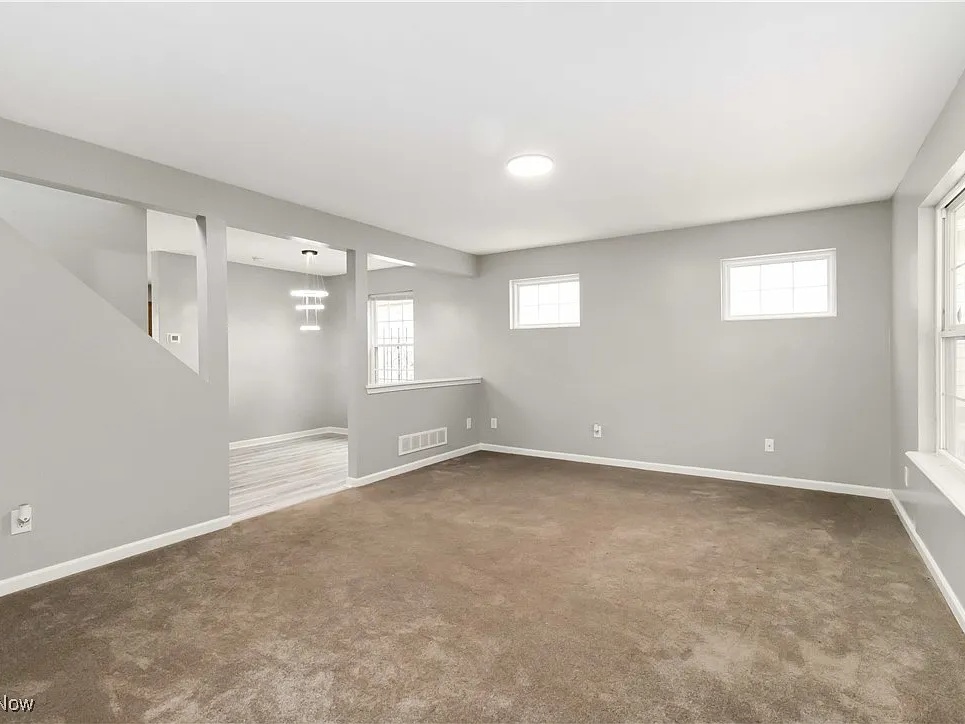

The Result: Your photo now matches the "dream" promised by your 3D floor plan. The buyer sees the layout (2D), feels the volume (3D), and falls in love with the style (Agent Lens).
Pro Tip: Want to test this? Agent Lens offers free credits on signup—no credit card required. You can stage a room in under 15 seconds to see if it matches your floor plan strategy.
6. SEO: The Hidden Traffic Driver
You know you need keywords in your description. But did you know your floor plans are SEO gold mines?
Google can't "see" an image, but it reads the text attached to it. Most agents upload a file named Scan_001.jpg. This is a wasted opportunity.
Rename your files before you upload.
❌ Bad: Floorplan_v2.jpg
✅ Good: 3D-floor-plan-open-concept-kitchen-Dallas-TX.jpg
Use Alt Text.
When you upload the image to your website or blog, fill out the "Alt Text" field.
Script: "2D schematic floor plan showing split-bedroom layout and large master suite in [Neighborhood Name]."
This tells Google exactly what the image is. When a buyer searches "homes with split bedrooms in [City]," your image—and your listing—has a better chance of showing up.
7. Competitor Analysis: Who Does What?
Matterport: The heavyweight champion. Incredible immersion. Downside: The "walled garden." You pay hosting fees forever. If you stop paying, your tour disappears.
CubiCasa: The disruptor. Fast, cheap, and creates both 2D and basic 3D/video renders from a phone scan. Downside: Less photorealistic than a high-end render, but "good enough" for 90% of listings.
BoxBrownie: The artist. You send a sketch; they send art. Downside: Slower turnaround (24-48 hours) compared to instant AI tools.
Zillow 3D Home: The ecosystem play. It’s free and boosts your listing on Zillow. Downside: Lower visual fidelity than Matterport.
Conclusion: Stop Guessing, Start Mapping
The debate isn't really "2D vs. 3D." It's "Clarity vs. Confusion."
In a market where inventory is tight and affordability is low, buyers are looking for reasons to say "no." Don't give them one. A confusing layout is an instant "no."
Your Playbook:
Always include a 2D plan. It’s the baseline standard for a professional listing.
Upgrade to 3D for unique layouts, luxury homes, or to feed the social media algorithm.
Align your photos. Use Agent Lens to ensure your listing photos are as clean and inviting as your floor plans.
You are a deal-maker, not a graphic designer. Use the tools that do the heavy lifting for you!
Free Real Estate Tools
Explore our free calculators and AI tools for agents:
Transform Your Listings with AI
Apply professional virtual staging and enhancements in seconds. Start transforming your listings today.
Explore Virtual Staging Options
Start with our most popular room & style combinations: