

The Six-Second Rule
You have exactly six seconds.
That is the average time a buyer spends on a listing’s main photo before deciding to click or scroll. For the last decade, you could win those six seconds with a bucket of white paint and black window trim. The "Modern Farmhouse" was the easy button.
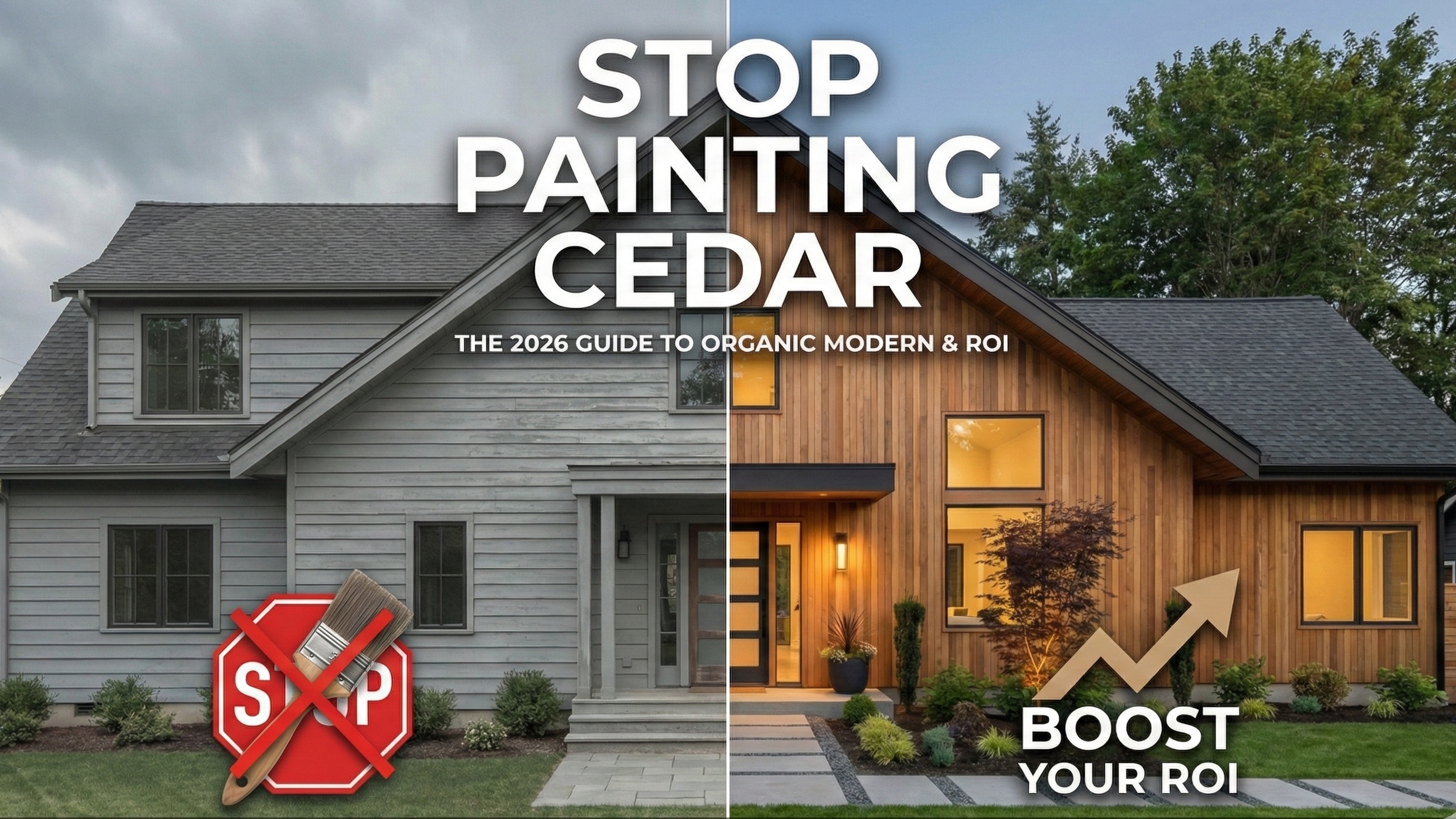
But the market has shifted. As we head into 2026, the "stark white" look feels dated and cheap. Buyers are demanding "Organic Modern"—a mix of warm textures, natural wood, and biophilic design. For agents and investors, this creates a dilemma: Do we paint it, or do we stain it?
Get this wrong, and you’re either peeling paint in three years (a maintenance nightmare) or hiding expensive cedar under cheap latex (value destruction). This guide breaks down the building science, the ROI math, and why legacy tools like Sherwin-Williams' apps are failing to capture the new wave of buyers.
1. The "Modern Farmhouse" Is Dead. Long Live Texture.
Let’s be honest: The "Flipper Special"—white board-and-batten with black windows—was great while it lasted. It was clean, safe, and easy to photograph. But in 2026, safe doesn't sell for top dollar.
The 2026 data from the National Association of the Remodeling Industry (NARI) and design reports paints a clear picture: buyers are craving warmth. They want Mixed Materials.
The New "Organic Modern" Standard
Instead of a monolithic white box, top-performing listings now feature a "triad" of materials:
Base: Painted siding (often in sage or warm greige).
Anchor: Stone or brick veneers.
Accent: Natural wood (Cedar, Cypress, or Redwood).
This isn't just an aesthetic preference; it's a value signal. Natural wood accents—whether it's a timber portico, exposed rafter tails, or a cedar garage door—signal "custom build" to a buyer's brain.
The Warning for Flippers: If you take a mid-century home with original cedar siding and paint it distinct "Tricorn Black" or stark white, you aren't modernizing it. You are erasing its equity. You are taking a premium material (natural wood) and treating it like a cheap material (vinyl).
2. The ROI Math: CapEx vs. OpEx
Stop thinking about color for a second. This is a math problem.
When advising a seller or calculating your own flip budget, you have to balance Capital Expenditure (CapEx)—what you pay today—against Operating Expenditure (OpEx)—what the owner pays later.
The "Paint" Equation
Upfront Cost: High. You need to pressure wash, scrape, sand, prime, and apply two coats. Labor is 80% of the ticket.
Lifespan: 8-10 years (best case).
The Hidden Cost: When paint fails, it fails hard. It cracks and peels. To fix it, you have to scrape it all off. That’s a massive future liability.
The "Stain" Equation
Upfront Cost: Low to Moderate. Stain is often "self-priming" and applies faster. It’s forgiving.
Lifespan: 3-5 years.
The Hidden Benefit: When stain fails, it just fades. There is no peeling. You wash it and recoat.
The Verdict: For a Fix-and-Flip, stain is the ROI king. It costs less to apply, looks premium immediately, and lets the wood grain do the selling.
NARI’s "Joy Score" Data
According to the latest remodeling impact reports, exterior curb appeal projects have massive returns:
New Steel Front Door: 100% to 216% Cost Recovery. (Pro Tip: Pair a painted black steel door with a stained wood frame for the ultimate 2026 look).
Manufactured Stone Veneer: ~206% Cost Recovery. This supports the "mixed material" trend.
3. The Science: Why Wood Needs to Breathe (Simplified)
You don’t need a chemistry degree, but you do need to know why paint peels so you can explain it to your sellers.
Think of wood as a sponge. Even after it’s cut and nailed to a house, wood is "hygroscopic." It breathes. When it rains or gets humid, the wood absorbs moisture and swells. When it’s sunny, it dries out and shrinks.
VS: Paint vs. Stain
Feature | PAINT (The Raincoat) | STAIN (The Lotion) |
|---|---|---|
How it works | sits ON the surface (Film). | Soaks INTO the wood (Penetrating). |
Reaction to Water | Blocks water completely. | Repels water but lets vapor escape. |
Reaction to Movement | When wood swells, paint stretches. Eventually, it snaps (cracks). | Moves with the wood. No film to crack. |
The Nightmare Scenario | Water gets behind the paint (through a crack). Sun hits it. Water turns to steam. Paint bubbles and peels off. | Stain just fades away gracefully. |
The Takeaway: If you paint moisture-rich wood (like Cedar) with a thick latex paint, you are essentially wrapping a wet sponge in plastic wrap and putting it in the sun. It will rot.
4. The "Red Flag" Competitor Audit
You know the trends. You know the science. Now, how do you show the client? The current tools on the market are failing agents in critical moments.
Here are the "War Stories" from the field:
🚩 RED FLAG: Sherwin-Williams "Bluetooth Fail"
The Tool: ColorSnap Match Pro (Hardware Device).
The Reality: Agents report constant connectivity drops. Imagine standing in a driveway with a high-net-worth client, waving a little gadget against the wall, and... nothing happens. "Hang on, let me re-pair my Bluetooth." The moment is gone. You look tech-illiterate.
🚩 RED FLAG: Behr's "Salmon Pink" Disaster
The Tool: Behr ColorSmart App.
The Reality: Color fidelity is terrible. A user selected "Old Adobe" (supposed to be terra cotta) and the app showed a nice earthy tone. On the wall? It dried as a bright, offensive "Salmon Pink." If you recommend a color based on this app, you might be paying for a repaint.
🚩 RED FLAG: Benjamin Moore's "Manual Masking"
The Tool: Personal Color Viewer.
The Reality: It requires you to sit at a desktop and manually trace the outline of the house with your mouse. It’s "manual masking." You cannot do this at an open house. It’s a homework assignment, not a sales tool.
🚩 RED FLAG: BoxBrownie's "Latency"
The Tool: Human-edited Virtual Renovation.
The Reality: It takes 24 hours to 7 days. In this market, if a buyer walks away to "think about it," you’ve lost them. You need to handle objections now, not next Tuesday.
5. The Solution: Agent Lens
You don’t have time to battle Bluetooth connections, and you can’t afford a "Salmon Pink" disaster. You need certainty, and you need it in seconds.
This is where Agent Lens changes the game. It solves the three biggest problems: Speed, Accuracy, and Texture. You don't need to be a Photoshop wizard, and you don't need to wait 48 hours for a render.
The 'Exterior Makeover' Mode
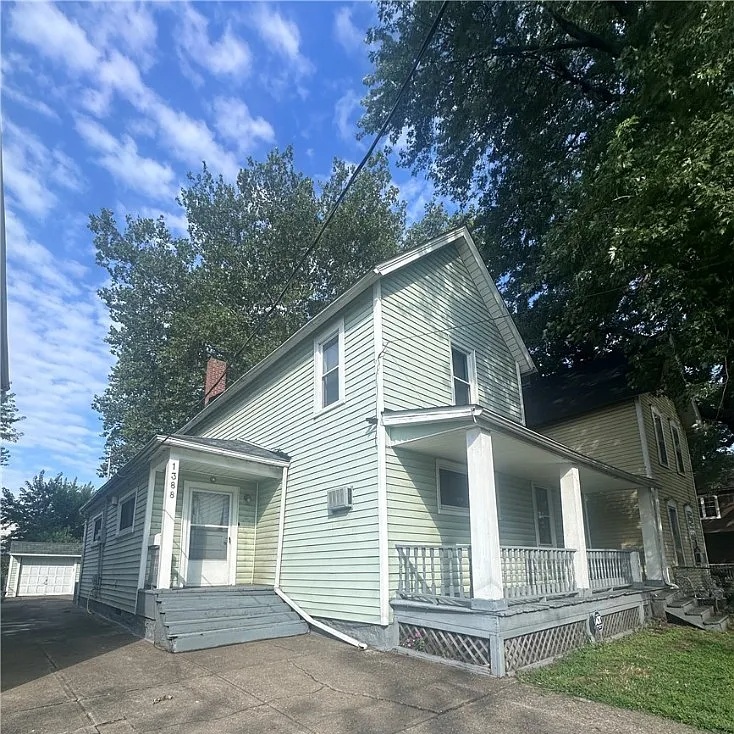
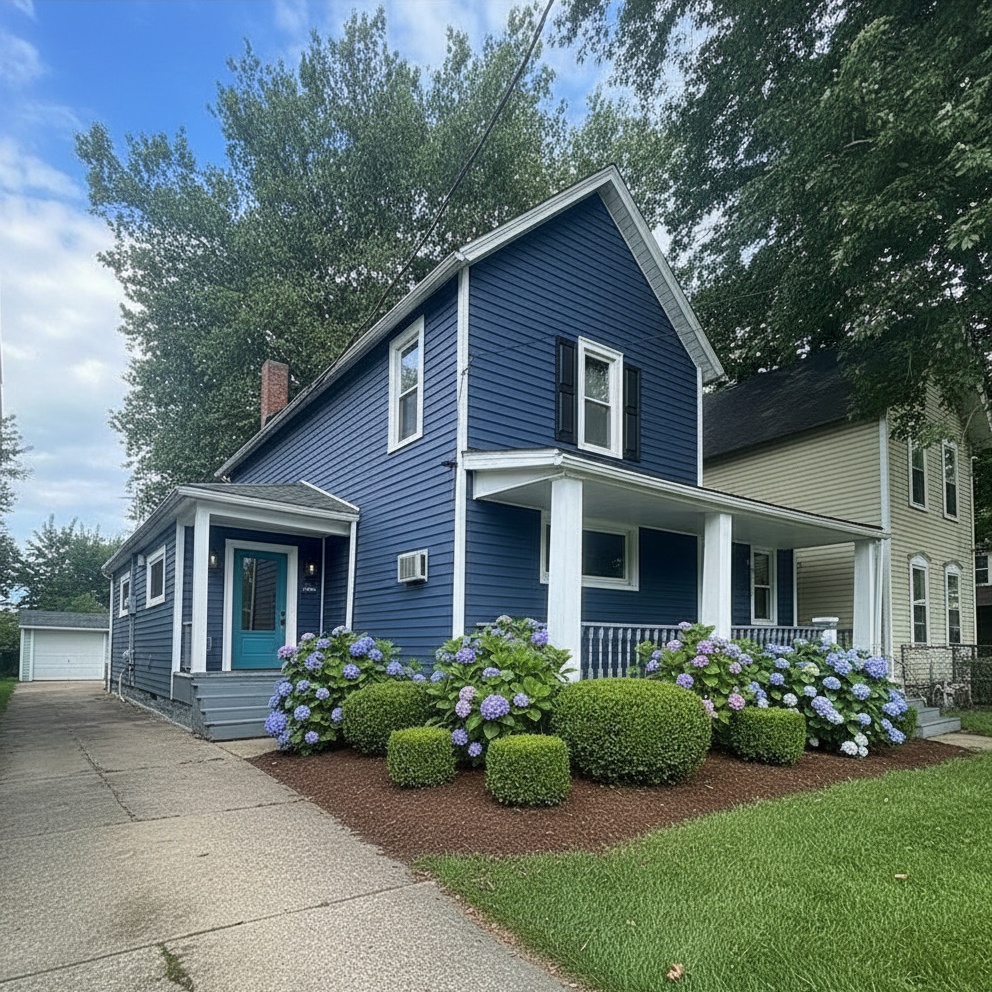
Agent Lens uses semantic segmentation (AI that "sees" the house). It instantly separates the siding from the windows, the roof from the sky, and the landscaping from the driveway.
How to use it on a listing appointment:
Snap a photo of the dated exterior.
Open the Agent Lens Chrome extension.
Select 'Exterior Makeover' mode.
Choose the "Organic Modern" preset.
It doesn’t just slap a flat color on; it generates the grain. The client sees the texture. They see the vision.
Bonus: Complete the Listing
While the 'Exterior Makeover' is your weapon for curb appeal, Agent Lens handles the rest of the property too:
Virtual Declutter: Wipe the junk off the porch but keep the furniture.
Curb Appeal Pro: Swap a gray rainy sky for blue and green up the grass.
Virtual Staging (Organic Modern Style): Drop teak furniture onto that empty patio to sell the lifestyle.
6. The 2026 "Virtual Flip" Playbook
Here is a specific strategy you can use tomorrow to generate leads.
The "Ugly Duckling" Listing Strategy
Find a home that is structurally sound but visually dated (yellow brick, peeling paint).
Take a Photo: Go to the curb. Snap a pic.
Run Agent Lens: Use 'Exterior Makeover' to apply a "Sage & Cedar" look.
The MLS Two-Step:
Photo 1: The current reality (be honest).
Photo 2: The Agent Lens render.
The Caption: "Don't just buy a house; buy potential. See Photo #2 for a digital rendering of this home transformed with 2026's hottest Organic Modern palette—Sage siding with Cedar accents."
The "Luxury Lexicon"
Stop saying "wood siding." Use words that signal value in your listing descriptions:
Instead of "brown wood," say "Sustainable Cedar Cladding."
Instead of "green paint," say "Biophilic Sage Palette."
Instead of "black trim," say "Urbane Bronze contrast accents."
2026 ROI Presets to Try in Agent Lens
The Naturalist: Dried Thyme (Sage) Body + Natural Cedar Accents.
The Moody Modern: Iron Ore (Charcoal) Body + Walnut Front Door.
The Coastal: Crisp White Body + Driftwood Shingles.
The Bottom Line: Sell the Vision, Not Just the House
The "Paint vs. Stain" debate isn't just about maintenance; it's about asset value. In 2026, a coat of solid paint on a beautiful cedar column isn't "protection"—it's a cover-up. It hides the very thing buyers are willing to pay a premium for.
Legacy tools like color fans and clunky apps can’t keep up with this textural shift. You can't ask a buyer to "imagine" how a peeling 1990s exterior could look as a Sage Green and Cedar masterpiece. The "Imagination Gap" is too wide.
Whether you're flipping a property or advising a seller, use the science of wood preservation and the speed of Agent Lens to win the listing. Don't just sell a house; sell the "Organic Modern" lifestyle they’re already scrolling for.
Install Agent Lens Extension – Get 3 Free Credit
Free Real Estate Tools
Explore our free calculators and AI tools for agents:
Transform Your Listings with AI
Apply professional virtual staging and enhancements in seconds. Start transforming your listings today.
Explore Virtual Staging Options
Start with our most popular room & style combinations: